
Does Changing Your Child's Diet Actually Help ADHD? Here's What the Studies Say
If you've read the first three posts in this series, you already know that processed food affects the ADHD brain in some very real ways, such as blood sugar crashes, low dopamine, and artificial dyes that create chaos in a brain already working overtime.
Knowing the problem exists is only half of it, though. The question most parents are asking is simpler: if we change what our child eats, will it help?
The honest answer is yes, for many kids, it really does. Here is what the research shows.
Half the kids got meaningfully better from food alone
A 2025 study followed 165 children aged 5 to 12 with ADHD for a full year (Huberts-Bosch et al., 2025). Half were guided toward a healthy whole food diet. Half continued eating as they normally would.
At the end of the year, 50% of the kids eating the whole food diet showed real, measurable improvement in their ADHD symptoms and emotional control. No new medication, no new therapy, just food. That is not a small finding.
That is half the kids in the study getting meaningfully better results in behavior, concentration, and focus from changing what was on their plate.
What about omega-3s?
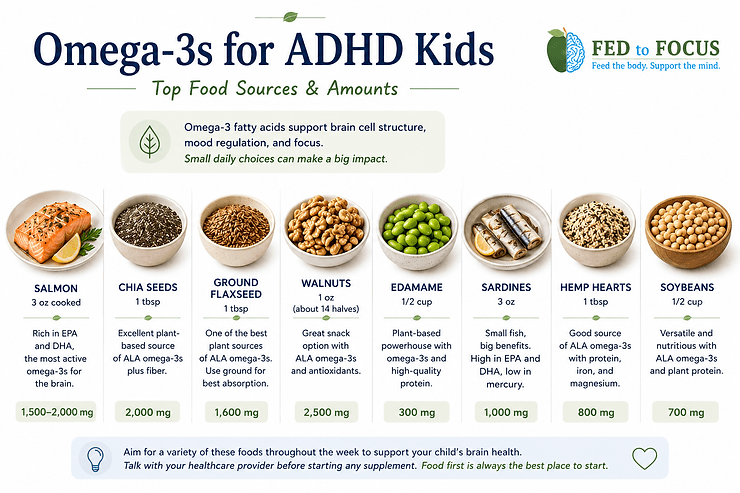
One of the most studied diet changes for ADHD kids is adding omega-3 fatty acids (the kind found in fish like salmon, walnuts, and flaxseed). Kids with ADHD are known to have lower omega-3 levels than other kids their age.
A review of 16 studies with over 1,400 children found that adding omega-3s led to real drops in hyperactivity that was noted by both parents and teachers (Hawkey & Nigg, 2014).
Another review of seven studies found it also helped with focus and attention (Bloch & Qawasmi, 2011). The effects are not huge, and omega-3s alone are not a fix, but across many studies the results are consistent.
When kids with ADHD get more omega-3s, the brain gets more of what it needs to regulate itself.
Does this mean giving up medication?
One of the biggest fears parents have is that trying a diet change means giving up their child's medication. The research is clear on this, it does not have to be one or the other.
A review published in 2025 found that changing what a child eats can work alongside medication, not against it (Nigg & Holton, 2025). Food and medication are working on the same brain systems.
Many families find that when they clean up their child's diet, the medication seems to work better, and some are able to have honest talks with their doctor about whether the current dose still makes sense.
The honest part
A diet change is not a cure for ADHD. Some kids respond a lot, and some respond a little. Some may not notice much difference at all. Results also take time. The year-long study saw its biggest gains after twelve months, not two weeks.
Very strict diets that cut out many foods at once can also put kids at risk for missing key nutrients, so that kind of approach needs medical guidance (Pelsser et al., 2017).
What the research does clearly support is this: moving away from packaged, processed food and toward real whole food is linked to better behavior and emotional health in a meaningful number of kids with ADHD, and there is no real downside to trying.
For a family that is already worn out from managing symptoms every day, that is a very good place to start.
Next up...
Post 5: From research to real life – practical clean eating strategies for families navigating ADHD.
References:
Bloch, M. H., & Qawasmi, A. (2011). Omega-3 fatty acid supplementation for the treatment of children with attention-deficit/hyperactivity disorder symptomatology: systematic review and meta-analysis. Journal of the American Academy of Child and Adolescent Psychiatry, 50(10), 991–1000. https://doi.org/10.1016/j.jaac.2011.06.008
Hawkey, E., & Nigg, J. T. (2014). Omega-3 fatty acid and ADHD: blood level analysis and meta-analytic extension of supplementation trials. Clinical Psychology Review, 34(6), 496–505. https://doi.org/10.1016/j.cpr.2014.05.005
Huberts-Bosch, N. N., et al. (2025). Effects of an elimination diet and a healthy diet in children with attention-deficit/hyperactivity disorder: 1-year prospective follow-up of a two-arm randomized, controlled study (TRACE study). JCPP Advances, 5(1), e12257. https://doi.org/10.1002/jcv2.12257
Nigg, J. T., & Holton, K. (2025). Dietary interventions for ADHD: emerging research and considerations. Psychiatric Times. https://www.psychiatrictimes.com/view/dietary-interventions-for-adhd-emerging-research-and-considerations
Pelsser, L. M., Frankena, K., Toorman, J., & Buitelaar, J. K. (2017). Diet and ADHD, reviewing the evidence: a systematic review of meta-analyses of double-blind placebo-controlled trials evaluating the efficacy of diet interventions on the behavior of children with ADHD. PLOS ONE, 12(1), e0169277. https://doi.org/10.1371/journal.pone.0169277

HEY, I'M MICHELLE.
I'm a former kindergarten teacher turned certified nutritionist and health educator, currently completing my Master's in Health Education and Behavior at the University of Florida.
After a decade in the classroom, I started noticing a pattern between what kids ate and how they showed up to learn, and I went back to school to understand why. I'm also a mom navigating this with my own child.
Fed to Focus is where I translate the research into something useful for your family.


JOIN MY MAILING LIST
©2026 Fed to Focus | Privacy Policy | Terms & Conditions