
From Research to Real Life: Practical Clean Eating Strategies for Families Navigating ADHD
You've made it to the last post in this series, and this is the one that matters most for your daily life. Posts 1 through 4 gave you the why. This post gives you the how.
Here's the most important thing to know before we start: this is not about being perfect. It's not about cooking every meal from scratch, cutting out every packaged food, or turning your kitchen upside down overnight. Small, consistent changes to your child's food environment add up to real results, and the research backs that up. You don't need willpower. You need a better set of defaults.
Start with breakfast. It sets the whole day
If there is one meal worth focusing on first, it's breakfast. As we covered in Post 2, what your child eats in the morning sets the neurological tone for their entire day. A breakfast built around protein, healthy fat, and fiber gives the ADHD brain stable fuel, raw materials to make dopamine, and a fighting chance before they even walk out the door.
In real life that looks like:
Eggs any style with whole grain toast
Greek yogurt with berries and a sprinkle of granola
Nut butter on whole grain toast with a banana
A smoothie with protein, a handful of spinach, and some frozen fruit
Overnight oats made the night before
None of these take more than ten minutes. The goal is simply to replace the blood sugar spike-and-crash of cereal and juice with something that keeps the brain steady until lunch.
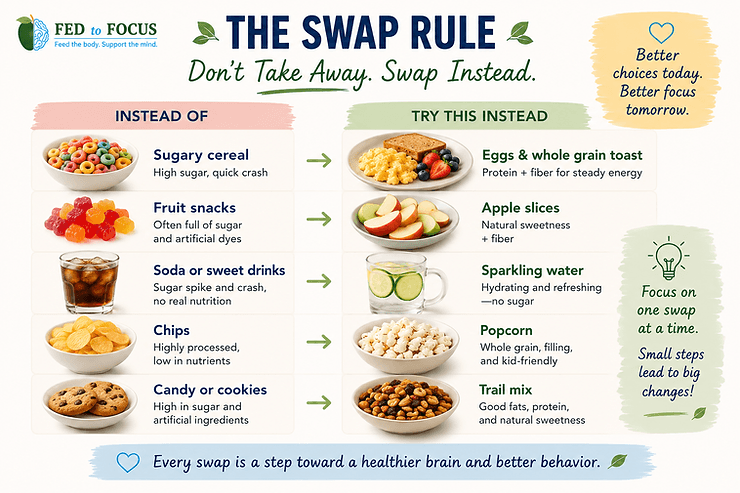
The swap rule: never remove without replacing
The biggest mistake families make is taking things away without putting something better in their place. When a favorite snack disappears with nothing to replace it, you get resistance, meltdowns, and a child who feels punished. Instead, think of every change as a swap and not a loss.
Start with your child's top three most-eaten processed foods. Just three. Look at what they are, check the ingredient list for artificial dyes using the names from Post 3 (Red 40 or Allura Red, Yellow 5 or Tartrazine) and find one dye-free swap for the one they eat most often. That single change reduces their daily dye load more than any other step you could take this week.
Add omega-3s without a battle
As the research in Post 4 showed, kids with ADHD consistently have lower omega-3 levels, and raising those levels is linked to calmer behavior and sharper focus. The good news is you don't need supplements to do this, though they can help. Whole food sources of omega-3s include:
Salmon and other fatty fish
Walnuts
Flaxseed or chia seeds added to smoothies or oatmeal
Eggs from hens fed an omega-3 enriched diet
Even getting fatty fish into your child's diet once or twice a week is a meaningful step in the right direction.
Change the environment, not just the food
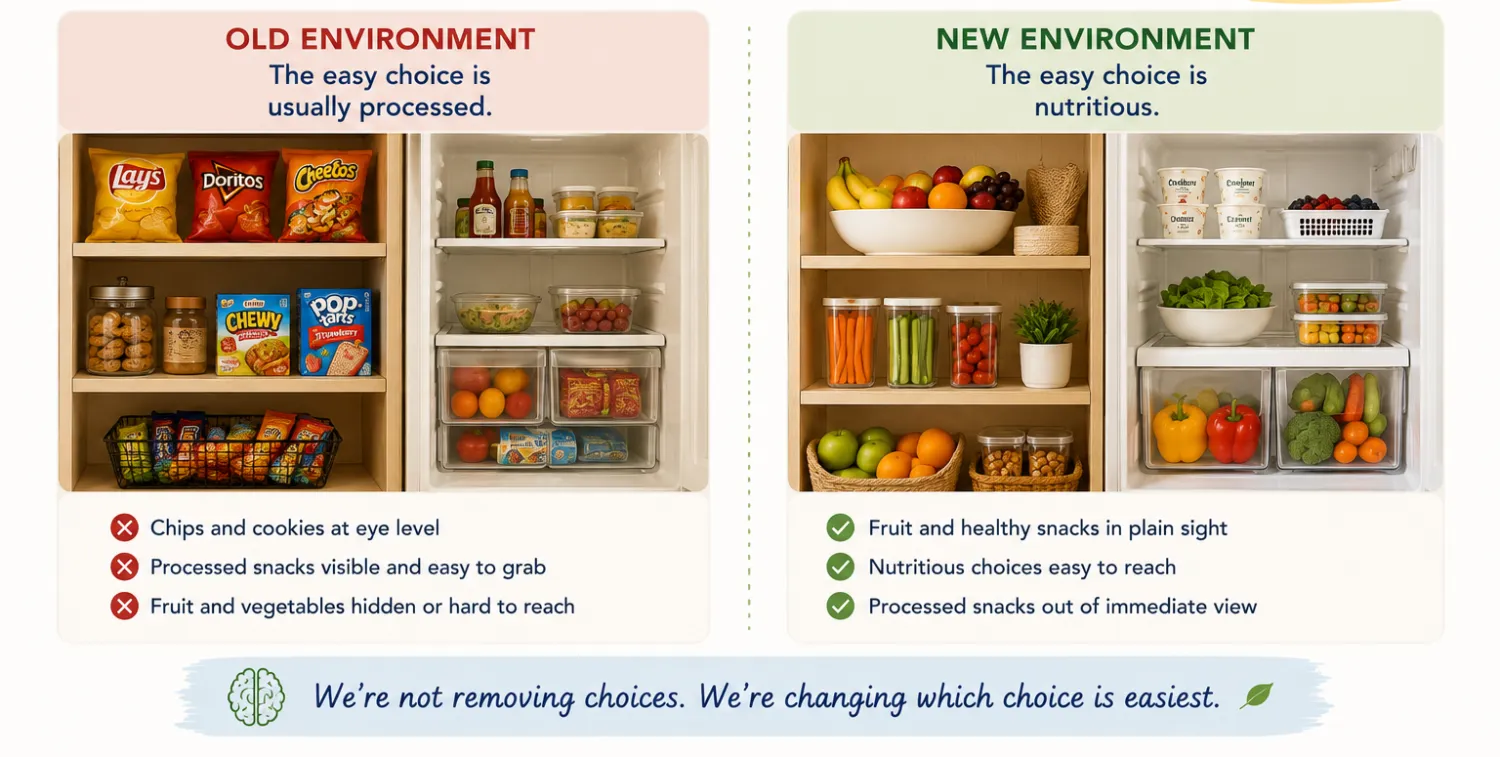
Here is the single most powerful strategy in this entire series, and it has nothing to do with what you cook. It has to do with what your child can see and reach.
The ADHD brain is wired to seek the fastest available reward. If chips are at eye level and fruit is in the back of the fridge, the chips win every time. Not because your child has no self-control, but because the environment is set up to make that the easiest choice.
Flip it. Put the real food where it can be seen and reached without effort. Put the processed snacks where they require more steps to get to. You are not removing choices, you are changing which choice is easiest. That is the whole game.
What a realistic week can look like
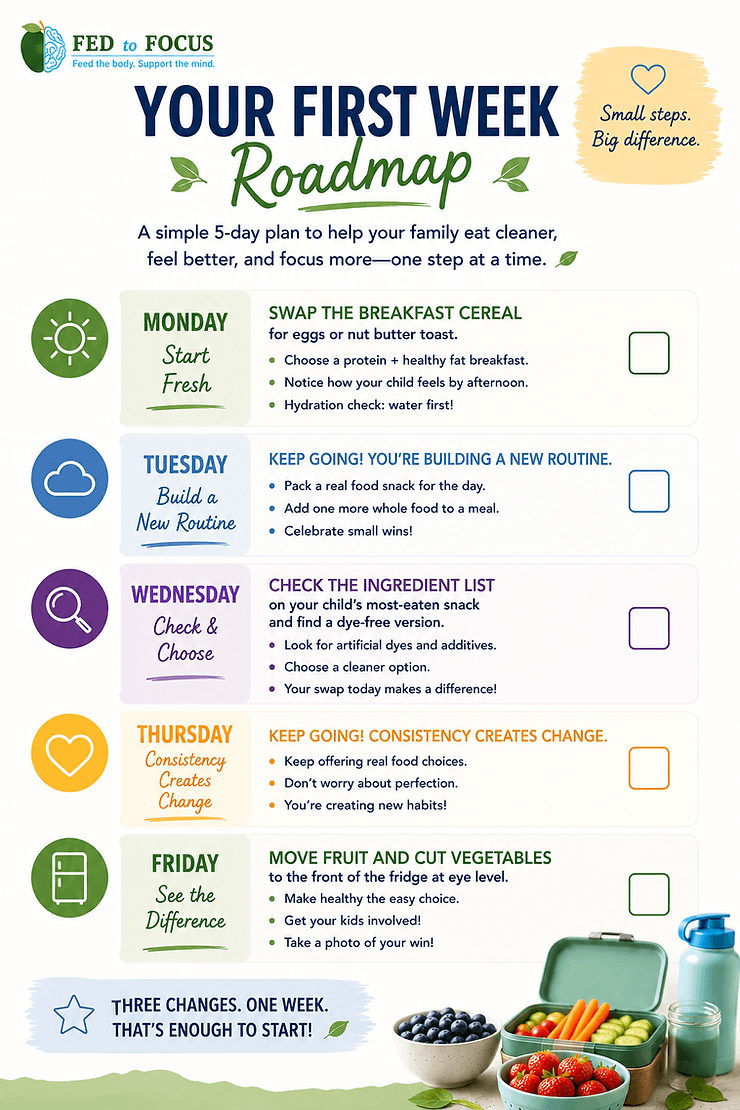
You don't have to change everything at once. A realistic first week might look like this:
Monday: swap the breakfast cereal for eggs or nut butter toast
Wednesday: check the ingredient list on your child's most-eaten snack and find a dye-free version
Friday: move fruit and cut vegetables to the front of the fridge at eye level
Three changes. One week. That is a different neurological environment for your child, and it is absolutely enough to start.
Save "Your First Week Roadmap" to get started!
A final word
Here's what I hope you take away from this series: you don't have to change everything overnight. Focus on one meal, one swap, or one new habit at a time. Small, consistent changes create a healthier food environment, and over time, that healthier environment can help support a calmer, better-fueled brain. Progress, not perfection, is what moves families forward.
References:
Galler, J. R., Vega, E., & Ramsey, J. M. (2025). A closer look at the role of nutrition in children and adults with ADHD and neurodivergence. Frontiers in Nutrition, 12, 1586925. https://doi.org/10.3389/fnut.2025.1586925
Nigg, J. T., & Holton, K. (2025). Dietary interventions for ADHD: emerging research and considerations. Psychiatric Times. https://www.psychiatrictimes.com/view/dietary-interventions-for-adhd-emerging-research-and-considerations
Pelsser, L. M., Frankena, K., Toorman, J., & Buitelaar, J. K. (2017). Diet and ADHD, reviewing the evidence: a systematic review of meta-analyses of double-blind placebo-controlled trials evaluating the efficacy of diet interventions on the behavior of children with ADHD. PLOS ONE, 12(1), e0169277. https://doi.org/10.1371/journal.pone.0169277
Walker, M. (2023). Unjunk America: Healthier eating in a processed world. Nicholabella Co LLC.

HEY, I'M MICHELLE.
I'm a former kindergarten teacher turned certified nutritionist and health educator, currently completing my Master's in Health Education and Behavior at the University of Florida.
After a decade in the classroom, I started noticing a pattern between what kids ate and how they showed up to learn, and I went back to school to understand why. I'm also a mom navigating this with my own child.
Fed to Focus is where I translate the research into something useful for your family.


JOIN MY MAILING LIST
©2026 Fed to Focus | Privacy Policy | Terms & Conditions